
 en
 English
 Español
 中文简体

Content
Steel modular construction is changing the way buildings are planned, fabricated, and assembled. Rather than coordinating dozens of trades on an open site, project teams design complete three-dimensional modules, manufacture them under factory-controlled conditions, and lift them into place on a prepared foundation. The result is a building approach that is faster, more predictable, and often more economical than conventional methods, especially for projects that repeat structural bays across a large footprint.
What Is Steel Modular Construction?
At its most basic, steel modular construction treats a building as a set of prefabricated volumetric units. Each module consists of a steel frame, including columns, beams, and bracing, plus whatever additional elements the project requires, such as floor decks, wall panels, insulation, or even fitted services. The modules are built in a factory, transported to the site, and joined together to form the completed structure.
The distinction from traditional steel erection matters. In conventional projects, loose members arrive at the site and are assembled one at a time. In modular projects, the difficult and time-consuming work happens indoors, where tolerances are controlled, welding is consistent, and the weather never interferes. That single change in workflow creates a cascade of benefits.
How the Modular Construction Process Works
Every steel modular project follows a similar path, even though the details vary with building type, size, and local regulations.
Design and Engineering
The design phase is where modular success is determined. Engineers must break the building into logical modules that respect transportation limits, crane capacities, and structural load paths. Connections between modules must be carefully designed so that vertical loads transfer cleanly through columns and lateral forces are distributed through the assembled frame. Early coordination among the architect, structural engineer, and fabricator is essential.
Factory Fabrication
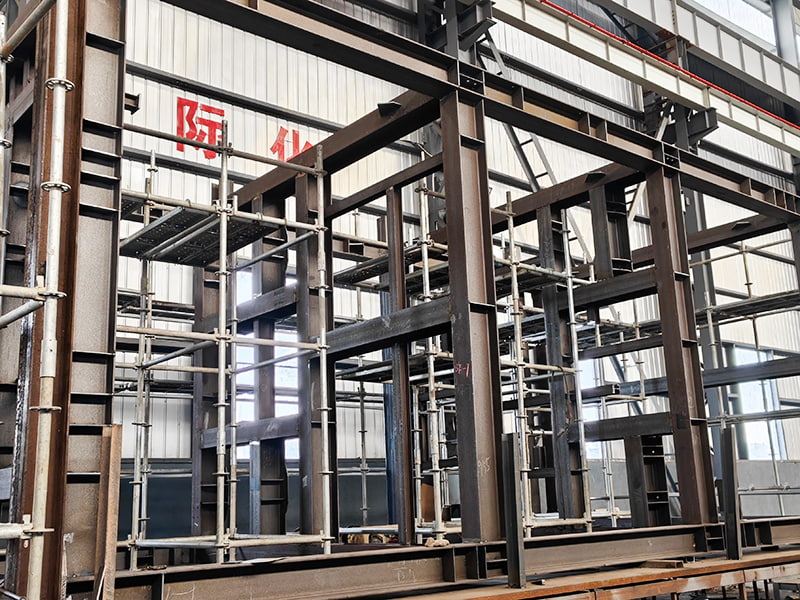
Once the module design is finalized, fabrication begins in the factory. Structural members are cut, drilled, welded, and painted with precision. In modern steel fabrication shops, robotic welding lines play a significant role in achieving uniform weld quality. As modules take shape, they can be fitted with floor plates, insulation, and even pre-finished interiors before they ship.
Transportation and Site Assembly
Modules are delivered in sequence to the building site, where a crane lifts them onto prepared foundations or previously placed modules. Bolted or welded connections lock them into place. Because the heavy lifting and fitting work is minimized on-site, the assembly phase is remarkably swift. Final site work concentrates on sealing joints between modules, connecting services, and completing exterior cladding.
Key Benefits of Steel Modular Construction
The advantages of steel modular construction are not theoretical; they show up directly in project schedules, budgets, and outcomes.
Speed of Delivery
Because module fabrication runs in parallel with foundation and site work, the overall schedule can shrink by weeks or even months. This parallelization is particularly valuable for industrial facilities, where an earlier production start translates directly into revenue.
Consistent Quality
Building modules in a factory means every weld, every cut, and every connection is made under the same controlled conditions. Inspections are simpler, tolerances are tighter, and the predictable quality reduces costly on-site fixes.
Lower Total Cost
Faster schedules reduce financing and site overhead costs. Fewer on-site trades reduce labor costs. Better material utilization reduces waste. Aggregated across a project, these savings make modular construction increasingly cost-competitive with traditional building.
Improved Safety
Moving work off the site removes workers from weather, heights, and the hazards of a busy construction site. Both the total labor hours on site and the duration of those hours are reduced, which has a measurable impact on safety performance.
Sustainability
Steel is infinitely recyclable, and modular fabrication generates significantly less scrap than traditional methods. The efficiency of delivery and assembly further reduces the carbon footprint of a project, which is an increasingly important consideration for developers and owners.
| Aspect | Traditional On-Site | Steel Modular |
|---|---|---|
| Schedule | Sequential; weather dependent | Parallel; weather independent |
| Quality control | On-site variability | Factory-consistent |
| On-site labour | High | Reduced |
| Material waste | Higher | Lower |
| Safety exposure | Greater | Minimized |
Applications Well-Suited to Steel Modular Construction
Steel modular construction works across a broad spectrum of building types. Three categories in particular demonstrate its strengths.
Heavy Industrial Plants and Workshops
Industrial buildings demand large clear spans, heavy-load capacity, and fast completion. Modular steel frames meet those needs exceptionally well. Manufacturing plants, equipment halls, and heavy-duty workshops benefit from the dimensional accuracy and speed that the modular method provides. For owners who need to get production lines running, every day saved matters.
 FAW-Volkswagen Industrial Plant Steel StructureA custom heavy-duty steel structure for an automotive plant, showcased as a completed reference for owners needing fast, accurate industrial construction.View Product →
Commercial Complexes and Multi-Story Buildings
Multi-story commercial buildings leverage the repetitive nature of modular construction beautifully. Each floor can be divided into identical modules, manufactured in parallel, and stacked efficiently on site. Office buildings, retail complexes, and institutional structures all fit this model. The integration of vertical circulation and MEP services within the module design keeps the site phase short and predictable.
 Multi-Story Frame Steel Structure for Large Integrated Office BuildingA customizable steel frame system for large commercial offices, backed by advanced manufacturing and certifications, ideal for modular multi-story projects.View Product →
Warehouses and Logistics Facilities
For warehouses and logistics centers, the structural grid is typically simple and highly repetitive, which makes modularization straightforward. High-bay storage areas, automated warehouses, and distribution hubs all gain from quick assembly and long, column-free spans. The speed of construction is especially valuable in logistics, where distribution capacity generates ongoing revenue.
Design Considerations for Modular Steel Projects
A successful modular project is not an accident; it is the product of disciplined design. Here are the factors that deserve attention in the planning stage.
Module Dimensions and Transport
Every module must fit on a truck, trailer, or ship and pass under the bridges and power lines along its route. Oversized modules trigger special permits and higher logistics costs, so dimensions are set early in the design process with input from transport specialists.
Structural Connections
Connections between modules must accommodate the loads of the fully assembled structure while being practical to close on site. Designers typically choose bolted connections for speed, with shop welding used within modules and site bolting between them.
Services and Fit-Out Integration
Plumbing, electrical, and HVAC systems are far easier to install in a factory than on a crowded site. The design should route services within each module and provide simple interface points at module boundaries. The more finish work that moves into the factory, the faster the site phase becomes.
Why the Fabricator Matters in Modular Construction
The entire value proposition of steel modular construction rests on the quality of the fabrication. A module that arrives at the site with out-of-tolerance dimensions, uneven welds, or connection mismatches defeats the purpose of the method. Choosing an experienced fabricator is therefore the single most important decision an owner or contractor makes.
Nantong Sudong Steel Structure Co., Ltd. has spent nearly three decades in the steel construction industry, serving clients across heavy industry, commercial building, energy, and public infrastructure. Our 50,000-square-meter production base houses seven fabrication lines, including six robotic welding lines and a box girder production line, giving us the capacity and precision that reliable modular delivery demands. With an annual output of 40,000 to 50,000 tons, we handle projects ranging from single buildings to large multi-building industrial complexes.
We are also equipped for the full delivery chain, including engineering detailing, fabrication, surface finishing, transport planning, and on-site erection. That single-point responsibility makes coordination easier and reduces the risks that come with fragmented subcontracting. To see how this capability plays out in practice, browse our project portfolio or take a closer look at our steel structure products.
Steel modular construction is more than a construction technique; it is a fundamentally smarter way to build. By combining the inherent strength of structural steel with the efficiency of factory production, it delivers speed, quality, and value that traditional methods struggle to match. The growing interest in modular approaches is not a passing shift; it is the natural direction of an industry striving to build better.