
 en
en
 English
  Español
  中文简体
中文简体

Content
When two fabricators quote the same 800-ton workshop and one comes back 20 percent cheaper, the reason is rarely the price of steel. It is almost always fabrication: how many unique parts the design contains, how the connections are detailed, and how much welding, handling, and rework each shop must absorb.
Steel structure fabrication is the controlled workshop process that turns rolled sections, plates, and hollow profiles into finished components ready for site erection — cutting, drilling, bending, welding, straightening, inspecting, and coating. The conclusion worth stating up front: fabrication quality decides whether a frame bolts together in days or fights you for weeks. The sections below walk through the process stage by stage, the tolerances that matter, and the checks a buyer should make before awarding a contract.
What Steel Structure Fabrication Involves, Stage by Stage
Many fabricators run production as a flow of five stages: material intake, cutting and hole-making, forming and fitting, welding, and coating. A defect created early becomes more expensive at every step after it, so each stage carries its own control points.
Preparation and cutting
Material arrives at the stockyard and is checked against mill certificates so that every beam and plate traces back to its heat number. Shot blasting usually comes next, stripping mill scale and rust so that welds and paint bond as designed. Cutting then divides the steel to size, and the right method depends on thickness, shape, and volume:
| Method | Typical use | Strengths | Watch-outs |
|---|---|---|---|
| Circular saw | Sections and bars | Clean, square, burr-free ends | Limited to smaller profiles |
| Flame (oxy-fuel) cutting | Thick plate, roughly 20 mm and above | Low tooling cost, handles heavy plate | Wider heat-affected zone; edges may need grinding |
| Plasma cutting | Medium plate and irregular profiles | Fast, narrow heat-affected zone | Bevel control on very thick plate |
| Drilling | Bolt holes | Precise position and diameter | Punching is faster on thin material but hardens the hole edge |
Forming, fitting, and welding
Plates are bent or rolled where the design calls for curves or stiffened shapes. Fitters assemble the pieces in jigs and verify alignment before any arc is struck. Structural welding falls into three broad groups: manual metal arc (MMA) for repair and site work, metal active gas (MAG) for general shop fabrication, and submerged arc welding (SAW) for long, heavy butt welds on beams and box girders, where deep penetration and consistent bead quality repay the equipment cost.
Welding also puts heat into steel, and heat changes the material. For members serving near furnaces, kilns, or fire-risk zones, it is worth knowing at what temperature structural steel loses strength, because a welding arc and a building fire stress the same property. Heavy box girders are where this discipline becomes visible in public: bridge members carry live loads measured in tonnes and depend on every centimeter of weld.
 CCCC Steel Structure Bridge FabricationThis bridge steel structure example follows the passage's point on heavy box girders carrying tonne-scale live loads. It shows how weld quality and fabrication discipline translate into members safe for public bridge service.View Product →
Coating and protection
After final inspection, components are blasted to the specified surface profile and painted or galvanized. Coating thickness is verified with dry film thickness gauges: too thin and the system will not reach its design life, too thick and it can crack. Slip-critical faying surfaces are masked or left bare exactly as the design requires.
Tolerances: Measured in Millimeters, Not Eyeballed
Structural steel is not machined like an engine part, but it is less forgiving on site than a drawing suggests. Common shop practice holds cut lengths within a few millimeters and hole positions to around a millimeter of their theoretical centers, while the camber in a long beam is deliberately built in so the member straightens under load. The binding figures always come from the project specification and the governing standard — EN 1090 in Europe, AISC codes in North America, GB 50205 in China — and the contract should name which one applies.
The discipline exists because of fit-up. A connection drilled three millimeters off may pass unnoticed in the shop, then cost hours of site reaming or a welded repair on a finished, coated member. Weld shrinkage pulls members out of line too, so experienced shops compensate during fitting instead of discovering the problem in trial assembly. A fabricator who talks readily about dimensional reports, fit-up checks, and camber control is telling you something useful; one who discusses tolerances only after a second request is telling you something else entirely.
Design Decisions That Drive Fabrication Cost
Fabricators price complexity before tonnage. A 500-ton frame built from forty repeated bay modules costs less per ton than a 300-ton frame with three hundred unique connections, because repetition amortizes programming, jigging, and inspection time across many identical pieces. Four decisions do most of the cost-setting before detailing even starts:
- Standardize bay sizes and member grades so that sections repeat and plate nesting waste drops.
- Prefer bolted site splices over field welding; bolting is faster, quieter, and far easier to inspect.
- Keep connections simple — a standard end plate beats an ornate gusset arrangement in both cost and quality risk.
- Invest in clean engineering documentation; a well-built model and unambiguous drawings remove many of the questions that stall a shop floor.
None of this means designing for the machine at the expense of the structure. It means recognizing that every line a designer draws becomes minutes of handling, cutting, welding, and inspection in the factory, and a good design makes those minutes predictable.
Quality Checks Worth Making Before You Sign
A capable fabricator will volunteer much of the following evidence; a buyer who asks for it in writing keeps it usable when a dispute surfaces two years later:
- Material traceability: mill certificates for every heat, matched to cutting lists.
- Qualified welding: approved welding procedure specifications and welder certificates for the actual joints in your project, not just generic qualifications.
- Non-destructive testing: ultrasonic testing for full-penetration butt welds and magnetic particle testing where specified, reported per weld rather than as a batch summary.
- Dimensional records: as-built surveys of primary members and trial assembly of complex nodes before coating.
- Coating verification: dry film thickness readings and surface profile checks logged by area.
- Transport and packing plan: member lengths checked against road limits, bolting sets bagged and labeled per assembly.
These records answer the immediate question of whether the frame will erect cleanly. They also feed the longer question of whether it will still be straight and tight in thirty years — an outcome that depends just as much on coating selection, drainage detailing, and maintenance access as on shop paperwork.
From Workshop Floor to Site Erection
Fabrication does not end at the last weld. Components travel, sometimes across oceans, and the handover between shop and site is where schedules are won or lost. Standard road transport favors members up to roughly twelve meters; anything longer or wider moves as an abnormal load with escorts and permit lead times. Export shipments add seaworthy packing, container or break-bulk planning, and port coordination on top.
Site erection rewards the same discipline. Sequenced bolting, torque checks, and survey verification keep each level true as it goes in, and this is where an integrated supplier earns its keep: when one team carries a project from design through fabrication to installation, connection clashes surface in the model instead of thirty meters in the air. Heavy industrial work shows the value clearly — a coal-mine plant structure or a petrochemical pipe rack leaves no room for improvised fixes once crane time is booked.
What Real Fabrication Capacity Looks Like
Claims are cheap in this industry; equipment and delivery records are not. Our own benchmark, built at Sudong since 1996, is a 50,000-square-meter production base running seven lines — six intelligent robot welding lines plus a box-beam line — with an annual capacity of 40,000 to 50,000 tons. Robotic welding matters to buyers in one specific way: it holds bead consistency across thousands of repetitive welds, which is exactly where manual fatigue shows up first in inspection results.
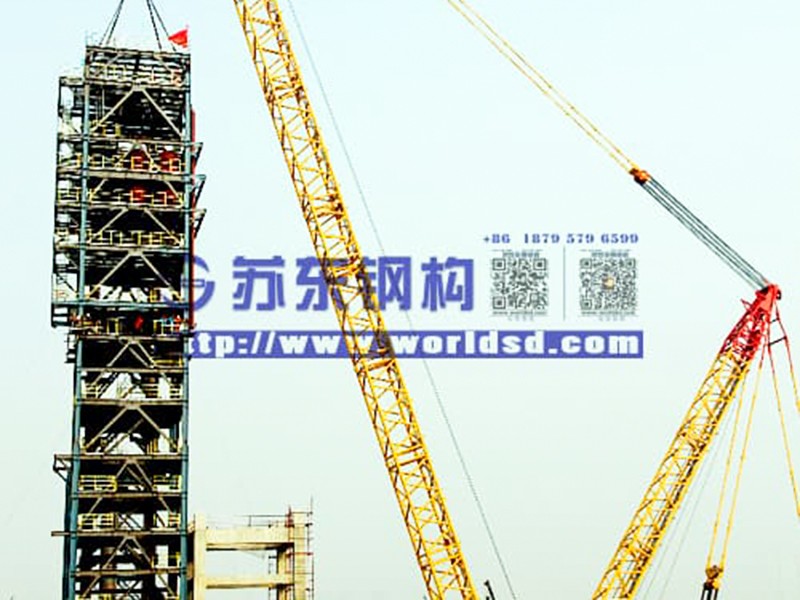 COFCO Heavy Steel Structure ProjectShown after the discussion of the Sudong production base and robotic welding capacity, this heavy steel structure project illustrates the range of shipped work, from energy-sector plate structures to export deliveries.View Product →
The range of shipped work is the second thing to weigh. Heavy plate structures for energy owners, welded box girders for highway bridges, pipe galleries, multi-story frames, and export projects delivered to Indonesia, Israel, Africa, and Japan each exercise a different part of a fabricator's system. Much of that record is visible in our project portfolio, and it is worth reviewing because a shop that has already solved those problems will solve yours faster.
Good steel structure fabrication is unglamorous: certificates that match, holes that line up, welds that pass ultrasonic testing the first time, paint applied to the specified thickness. Every one of those outcomes is set by process control in the workshop, long before the first column is erected. Buyers who spend an hour verifying that control — or better, walking the line in person — routinely save months on site, and nowhere more than on heavy-duty industrial plants, where loads are high and downtime is expensive.
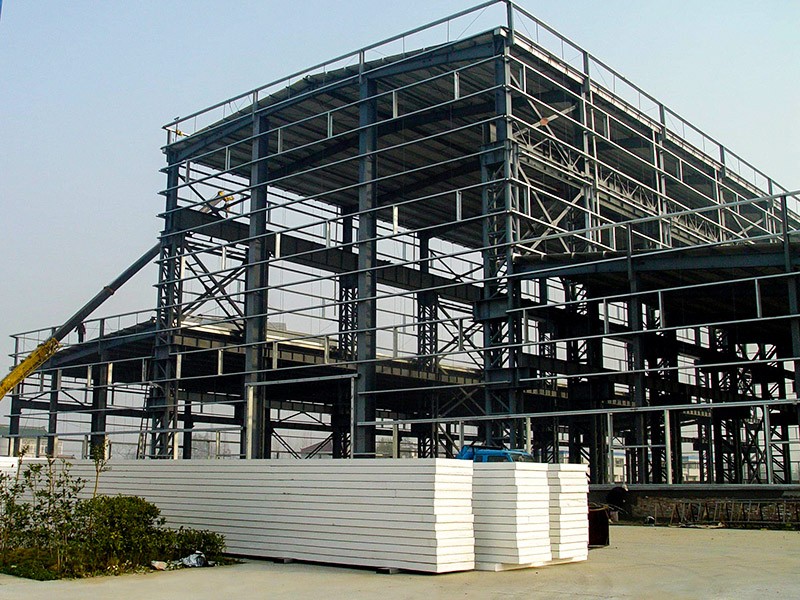 Heavy Duty Industrial Plant ManufacturingThe article closes on workshop process control saving months on site. These heavy-duty industrial plant projects demonstrate fabrication where loads are high and downtime is costly, with TEKLA modeling and drawing review support.View Product →