
 en
 English
 Español
 中文简体

Content
- 1 What "Blast Resistant Steel" Really Means
- 2 How Steel Absorbs Blast Energy
- 3 Choosing the Grade
- 4 Fabrication and Welding: Where Blast Resistance Is Won or Lost
- 5 Detailing Rules Worth Repeating
- 6 Where Blast-Resistant Steel Structures Are Used
- 7 Standards and Verification
- 8 Inspection and Long-Term Performance
- 9 Working With a Fabricator Who Has Seen It Before
Ask an engineer what blast resistant steel is and you will usually get a short pause followed by a good answer: there is no single "blast grade". A steel structure survives an explosion because a suitable material is combined with tough properties, ductile connections, a forgiving structural layout, and fabrication work that leaves no crack waiting to run. That combination, not one line on a mill certificate, is what keeps a building standing after an accidental detonation.
Sudong has been fabricating heavy steelwork since 1996, and most of what we build sits in exactly the facilities where this question comes up: refineries, chemical plants, power stations, port terminals and heavy manufacturing halls. What follows is how we approach the subject in the workshop, not just on the drawing board.
What "Blast Resistant Steel" Really Means
Blast resistant steel is structural steel that has been selected, detailed and fabricated so a member can deform plastically under a very short, very high pressure pulse without fracturing, and so the frame keeps a continuous load path after part of it has been damaged. The design intent is life safety and collapse prevention, not an undamaged building. Engineers accept permanent deformation, even a permanently bowed column, provided the structure holds and people can get out.
In practice there are two families of solution:
- Ductile structural framing. Ordinary hot-rolled sections, plate girders and composite floors designed so energy is absorbed through controlled yielding at chosen locations. This is what most industrial projects use.
- Sacrificial or hardened elements. Blast walls, steel-plate composite panels, hardened cladding and standoff structures that take the pressure so the primary frame does not have to.
Both routes rely on the same underlying property of steel: it can bend a great deal before it breaks, but only if the material, the weld and the connection detail all allow it to.
How Steel Absorbs Blast Energy
A blast load arrives in milliseconds. Steel responds with a higher effective yield strength at that strain rate, which helps, but the same speed of loading makes brittle behaviour more likely wherever toughness is marginal or a detail concentrates stress.
Toughness matters more than strength
A moderate grade with a guaranteed impact energy at the lowest expected service temperature is worth more than a high-strength plate with no Charpy record. Where the structure also runs cold, a coal handling gallery in the north or an LNG terminal, the toughness requirement should be stated for the service temperature, not for the ambient temperature on the day of the test. Thick plate deserves extra attention: as thickness grows, through-thickness restraint rises and the heat-affected zone becomes the weakest link.
Connections decide the outcome
Blast demand punishes connections. Bolted end plates, gusset plates and weld access holes are where fractures start. Capacity design, in which connections are given over-strength relative to the members they join, pushes yielding into the beam or brace where ductility is available and inspection is easier. A frame with strong members and ordinary connections is not a blast-resistant frame.
Choosing the Grade
Most blast resistant steel structures are built from familiar structural grades. What changes is the purchase specification: impact testing, chemistry control for weldability, and thickness tolerances that keep fit-up tight during erection.
| Grade | Typical role | Points to confirm |
|---|---|---|
| ASTM A36 | Secondary framing, base plates, stiffeners | Good ductility, but impact testing must be ordered as a supplement |
| ASTM A572 Gr. 50 | Columns, beams, plate girders | Higher strength keeps sections compact; toughness depends on the supplement requested |
| ASTM A992 | Wide-flange beams and columns | Controlled chemistry for weldability and a consistent yield range |
| EN 10025 S355J2 | Primary framing on European projects | Impact tested at minus 20 degrees Celsius as standard |
| EN 10025 S420 / S460 | Heavily loaded columns, transfer structures | Needs matched consumables and strict heat input control |
Three clauses are worth writing into any order for this type of work: Charpy V-notch testing at a stated temperature, a limit on carbon equivalent, and ultrasonic inspection of plate in heavy sections.
Fabrication and Welding: Where Blast Resistance Is Won or Lost
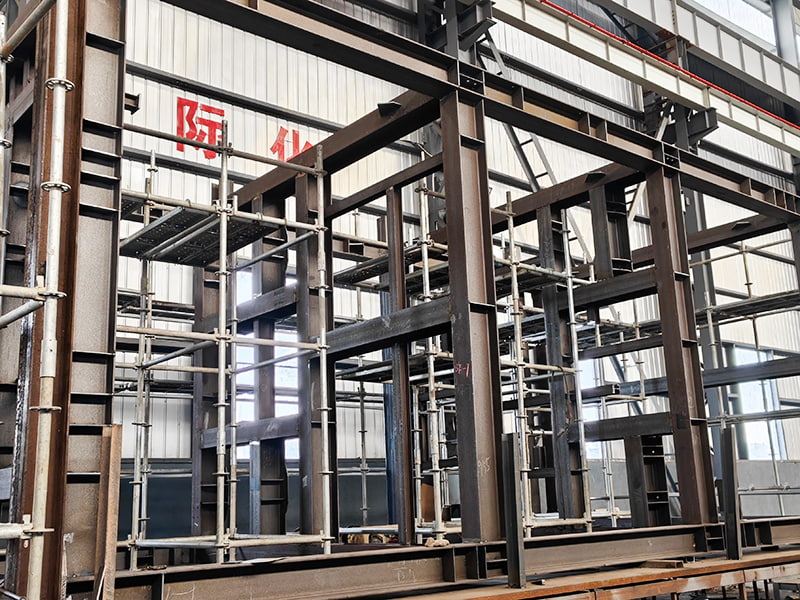
Blast resistance is often lost in the weld shop rather than in the design office. Heat input controls the toughness of the heat-affected zone, preheat and interpass temperature control cracking in thick plate, and consumables must be matched to the parent metal rather than chosen from what happens to be on the shelf. For heavy box sections and thick flanges, we qualify procedures with impact testing of both weld metal and heat-affected zone instead of relying on tensile results alone.
Consistency matters as much as technique. Our 50,000 square metre base runs seven production lines, six of them robotic welding lines, together with a dedicated box beam line, at an annual capacity of 40,000 to 50,000 tonnes. Automated welding is not automatically better, but it does hold heat input and bead placement steady across hundreds of identical connections, and those repeated joints are exactly where a blast-resistant frame is most sensitive.
Dimensional control belongs to the same story. A gap that will not close means a bolt that will not preload, and an un-preloaded bolt is a connection that fails earlier than the analysis assumed.
Detailing Rules Worth Repeating
- Keep the load path continuous from cladding to foundation, and make every transfer explicit on the drawings.
- Move plastic hinges away from weld access holes, copes and backing bars, and finish those details before inspection.
- Identify demand-critical welds, then inspect them fully rather than by sampling.
- Provide continuity plates and stiffeners at column-to-beam joints so the column face does not govern.
- Design ties that allow catenary action to develop if a column is lost.
- Keep primary members out of the direct pressure zone wherever the layout makes it possible.
Where Blast-Resistant Steel Structures Are Used
This kind of design shows up most often in refineries, petrochemical and fertiliser plants, LNG terminals, coal handling and power stations, and any industrial hall where a gas cloud or dust hazard has been identified. It also appears in transport and infrastructure work, from control buildings to bridges with security exposure.
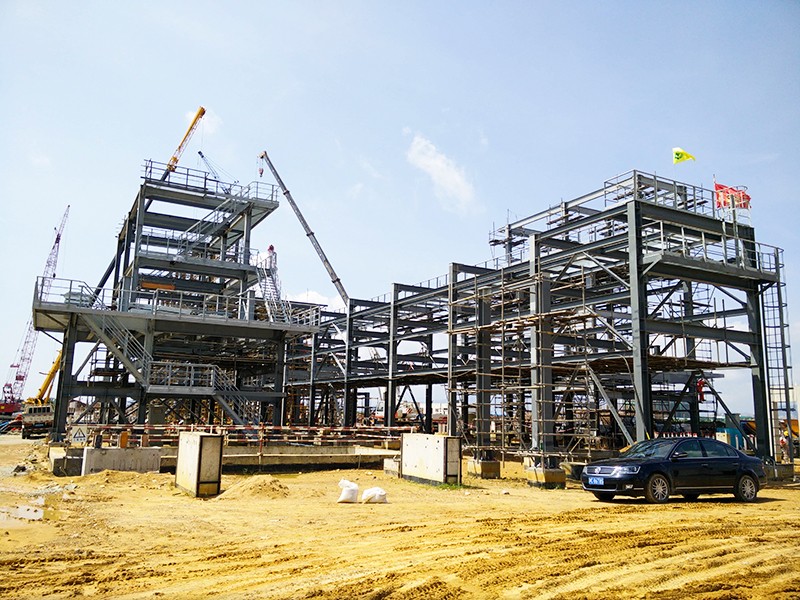
Petrochemical pipe galleries are a good illustration: long, repetitive, lightly loaded structures where a single rupture can load many bays at once, so continuity and connection ductility carry the whole performance.
 Custom Sinopec Petrochemical Pipe GalleryA custom Sinopec pipe gallery product for petrochemical facilities, where long repetitive structures depend on continuity and ductile connections.View Product →
Heavy structures for port and offshore facilities face a related set of demands, impact, fatigue and accidental load among them, and the detailing disciplines overlap considerably.
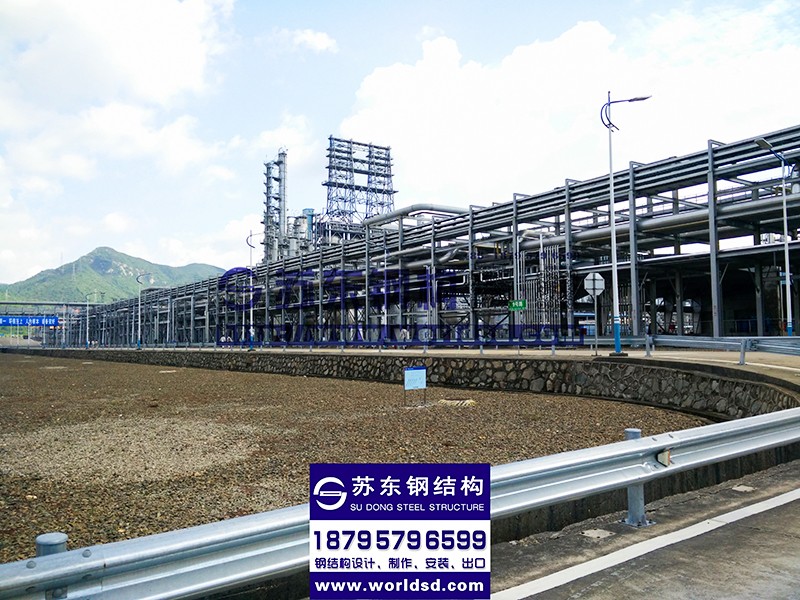 CNOOC Custom Heavy Steel StructureCustom CNOOC-related heavy steel structure for public infrastructure, presented by a supplier with design, fabrication and construction capabilities for demanding facilities.View Product →
Power generation is another common case, where blast and fire scenarios are assessed together and the same members must satisfy both.
 Shenhua Power Plant Steel StructureA power-plant steel structure offering for inquiry under nuclear and electric power categories, relevant where blast and fire scenarios are considered together.View Product →
Standards and Verification
Design guidance varies by market: ASCE/SEI 59 in the United States, UFC 4-010-01 with PDC TR 06-08 for defence work, EN 1991-1-7 for accidental actions together with the Eurocode 3 design rules, plus operator specifications from the oil and gas sector. They differ in detail but agree on the essentials:
- a defined threat and standoff distance;
- permitted response limits expressed as support rotations or ductility ratios;
- a stated material toughness requirement at a stated temperature;
- connection over-strength factors that keep yielding in the members.
On the fabrication side, work is verified against AWS D1.1 or EN 1090-2 execution classes, with procedure qualification records, welder qualification and non-destructive testing documented for the client's records.
Inspection and Long-Term Performance
A blast-resistant frame is only as good as its inspection trail: mill certificates with impact values, qualified procedures, non-destructive testing of demand-critical welds, dimensional survey before shipment and coating inspection before handover. Durability deserves equal attention, because a frame that corrodes at a connection loses precisely the ductility it was designed to rely on. Our notes on why high-quality industrial steel structures last for decades cover that side of the problem in more detail.
Working With a Fabricator Who Has Seen It Before
Nearly thirty years of heavy steelwork teaches a simple lesson: the questions asked before the first plate is cut decide most of the outcome. We would rather discuss the threat case, the service temperature and the inspection regime than quote a tonnage and hope. Our role covers design support, fabrication, protective systems and site installation, backed by in-house engineering, an export business that has delivered to projects in Asia, Africa and the Middle East, and documentation in English, Spanish and Chinese.
If you are planning a facility where accidental loading has to be taken seriously, it helps to look at what has already been built and tested in service. You can review our completed steel structure projects for examples across petrochemical, power, heavy industrial and public infrastructure work, then send us the drawings and let the detailing conversation begin.